
What the Class of Estimate is Telling You
AACE has established a common cost estimate classification system that aligns with typical project phase-gate steps to provide a common understanding of the expected scope definition and maturity associated with each estimate stage or class. AACE’s Recommended Practices on its cost estimate classification system provide thorough guidelines on the concepts, definitions, and development process associated with the classification of cost estimates and have been expanded to include different Recommended Practices on this topic applicable to specific industries (e.g. process industry, mining and mineral industry, nuclear industry, etc.).
Within the construction industry, use of AACE’s classification of cost estimates is fairly widespread, particularly for estimates supporting project authorization. However, this common application of the estimate classification system runs the risk of misinterpretation by project stakeholders into what the class of estimate is really telling them. Within this article, we examine the nature and characteristics of AACE’s estimate classification system including what each estimate class is typically used to support and how to interpret the expected accuracy range of the estimate.
Estimate Classes
The maturity of project definition deliverables directly correlates to the class of estimate able to be generated, with this maturity roughly defined by the overall percent complete of engineering for the project. Within the initiation and planning phases of a project, project definition is naturally limited, with most project data at a preliminary state while some project data is yet to be determined. As noted above, this limited level of project definition supports a Class 5 and Class 4 estimate and is often used to screen the viability of proposed concepts, albeit with a wide range of potential costs given the limited project definition.
As the project advances, a Class 3 estimate typically provides the first control budget to monitor cost performance during project execution. At the Class 3 estimate level, engineering is expected to be 10-40% complete and with most of the project characteristics having advanced to a defined state with reviews and approvals completed, though some aspects (e.g. startup and commissioning plans for a power plant) may remain in a preliminary state at this time. AACE’s collection of Recommended Practices on its cost estimate classification system provides specific estimate input checklists and maturity matrices to help guide how the status of distinct project definition deliverables supports different classes of estimate. These estimate inputs are also identified within the basis of estimate prepared in conjunction with the project estimate to allow reviewers to have a clear understanding of the information and assumptions used in developing the estimate.
With more project definition in a Class 2 estimate, it typically supports a detailed contractor control baseline (and updated owner control baseline). Some organizations may also use the Class 2 estimate to make funding decisions. While Class 1 estimates are generally prepared for discrete portions of the project to support subcontractor bidding or to evaluate claims and change orders. When a project’s control budget is established with the Class 3 estimate, it is common practice for the project to re-baseline its cost (and schedule) through the completion of the more detailed Class 2 and Class 1 estimates.
Expected Accuracy Range
One of the more commonly utilized aspects of AACE’s cost estimate classification system is the expected accuracy range attributed to each class of estimate. In line with increased project definition, the expected accuracy range will be tightened as shown in the figure below.
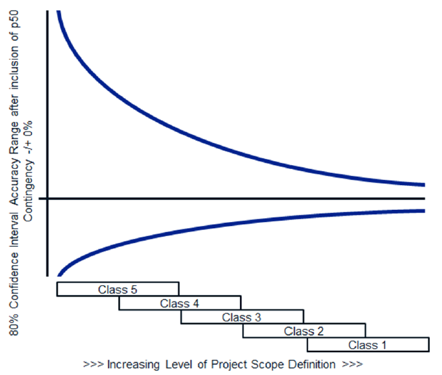
Variability in accuracy ranges for the process industries
Within AACE’s Recommended Practices on its cost estimate classification system, each class of estimate is tied with an expected accuracy range represented by a +/- percent of typical variation (after application of contingency). For example, within Recommended Practice 115R-21 (Cost Estimate Classification System for the Nuclear Power Industries) a Class 3 estimate is shown to have an expected accuracy range of -10% to -20% on the low end and +20% to +60% on the high end. As a practical example, this would mean for a Class 3 estimate of $8 million, the expected accuracy range may be from $6.4 million to $12.8 million. This degree of variance can present challenges as Class 3 estimates are often tied to the control budget for a project, making it critical for the project management team to understand and appreciate the key factors that can influence estimate accuracy beyond the project definition.
AACE identifies several systemic risks within its suite of Recommended Practices that drive estimate accuracy, which include:
Level of familiarity with technology.
Unique/remote nature of project locations and conditions and the availability of reference data for those.
Complexity of the project and its execution.
Quality of reference cost estimating data.
Quality of assumptions used in preparing the estimate.
Experience and skill level of the estimator.
Estimating techniques employed.
Time and level of effort budgeted to prepare the estimate.
Market and pricing conditions.
Currency exchange.
Other industry-specific factors are also provided within the industry-specific Recommended Practices, such as regulatory, community, landowner, and political risks associated with pipeline projects.
While many of these factors will be known or familiar to the project team, their impact on the estimate itself may not be fully appreciated. AACE indicates that research has shown weak project systems or otherwise risk projects may have accuracy ranges two to three times higher than indicated.
Beyond these systemic risks and general project definition, research on megaprojects specifically has identified additional factors that can influence estimate accuracy and cost performance, including optimism and uniqueness biases. Optimism bias relates to pressure to present a favorable estimate or maintain a prior estimate despite strong evidence suggesting higher costs. While uniqueness bias relates to planners and project managers viewing their project as unique enough that it may not face the same issues realized on other projects, limiting the ability to incorporate lessons learned while also increasing the overall risk to the project as a result.
Closing Thoughts
We’ve discussed what the difference classes of estimate are typically used for, how the project definition drives the class of estimate, and key factors that influence the estimate accuracy.
The takeaway from this information is the importance of having thorough estimate development processes aligned with industry recommended practices, including specifically a robust risk assessment to support each estimate and generating a sound basis of estimate to allow the estimate reviewer to have awareness into the estimate development process, including expected uncertainty and any known deficiencies. Without this full estimate effort in place, your Class 3 estimate may actually be a Class 4 estimate, leading to a false sense of confidence and an increased likelihood of cost overruns in execution.