
Regulatory Approval of Electric Utility Projects Before Full Project Definition
Within this article, we review the common project approval process for regulated electric utilities, including what information typically supports the project’s application to its regulator, the limitations of that information and risks associated with that limited project definition. Examples of such risks are demonstrated through the real-world experience on two novel, first-of-a-kind projects, which includes discussion on how the respective Commissions for the utilities sponsoring these projects addressed these risks.
How are Regulated Electric Utility Projects Typically Approved?
While sometimes differing in specific name, many states utilize a Certificate of Public Convenience and Necessity (CPCN) process to provide regulatory approval for electric utility projects and programs. A CPCN specifically provides regulatory approval from a state utility commission to allow the commencement of construction on major electrical power plants, transmission lines, and similar infrastructure. From state-to-state the specific requirements for a CPCN vary as do the project characteristics that require a CPCN – for example, Wisconsin’s Public Service Commission requires a CPCN for power plants with a rated capacity of 100 megawatts or more, while Maryland’s Public Service Commission requires a CPCN for power plants with a rated capacity of 2 megawatts or more (with certain exemptions available up to 70 megawatts). Ultimately, the Commission’s role is to assess the proposal and approve a CPCN if the project is found to be in the public interest, including reasonableness of costs and environmental impacts.
At a high level, the steps for applying for and receiving a CPCN are fairly common state-to-state and usually involve the following sequential steps:
Public informational meetings by the Sponsor: Public meetings held by the project sponsor to inform the public of the project.
CPCN application submitted to the Commission: Formally initiates the docket for the project with the sponsor/applicant providing general information about the project need, its cost, size, technology, and location.
Public notification on application: Notification to the public, including local government officials and other interested parties, by the Commission on the application.
Pre-hearing conference: Commission and the involved parties meet to set parameters around the hearing for the project, including timeline for submitting pre-filed testimony and dates for the hearing itself.
Hearing(s): Provide a venue for the parties, including the public, to provide on the record comments in favor of or in opposition to the overall project or specific aspects of it, supported by testimony and exhibits for the parties of record. In some areas, the public hearing will be separate from the evidentiary hearing that involves the sponsor and other parties of record on the docket.
Decision: Following the hearing process, including exchange of informational requests, the Commission will issue an order approving or denying the issuance of a CPCN.
The duration from application to decision varies and is largely driven by project cost and complexity, though it is usually a six to eighteen month process for most projects. The CPCN itself provides the authorization to commence construction, while the Order approving the CPCN will typically include details of the rate recovery mechanisms, reporting requirements, and prudency reviews required during or after project completion, among other details.
What Information is Typically Included in the CPCN Application?
The specific requirements to be included in a CPCN application are usually defined by state statute but typically include standard information such as: project location, design and operational features, project cost and schedule, explanation for the reasons behind the selected project (often with comparisons of alternatives), and impacts to the local economy and electrical system. The information within the CPCN application is generally considered to be conceptual in nature with some preliminary engineering complete, while detailed engineering commences after the CPCN is received.
The amount of definition and completeness within the CPCN application naturally varies, particularly depending on how novel the proposed project and its technology are. The following table provides a view on how advanced different components commonly are to support a CPCN application on a typical project.
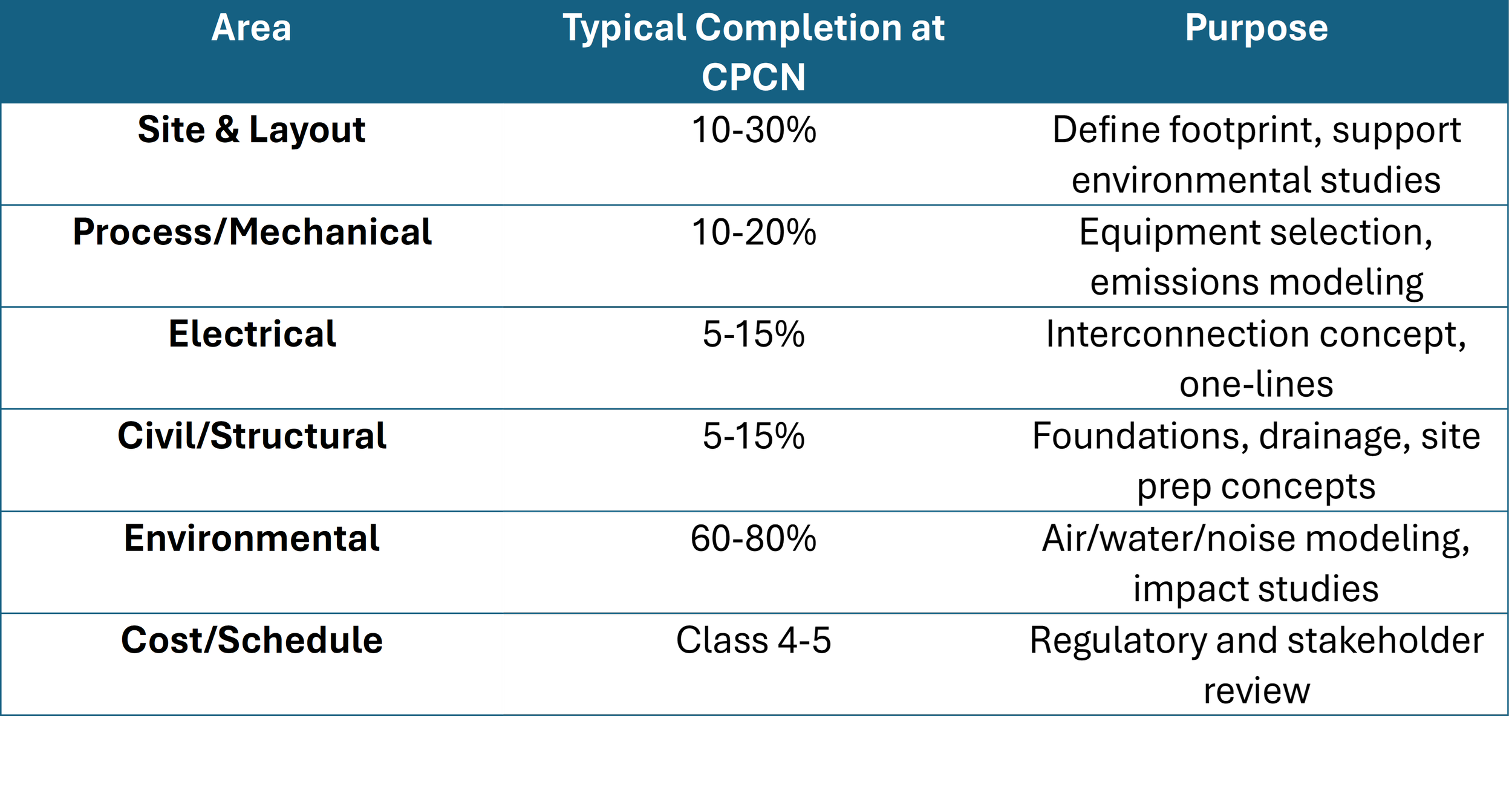
Maturity of different elements at the time of the CPCN application.
As illustrated in the above table, much of the project definition is preliminary or conceptual in nature at the time of the CPCN application. While this is expected given the overall timeline for project development, it does present risks and uncertainties that parties and stakeholders should be aware of and prepared to address. In particular, the likelihood for cost and schedule growth as the project becomes more defined, which is particularly heightened for more novel technologies and first-of-its-kind type scopes of work. These first-of-a-kind technologies not only involve heightened cost and schedule risks, but also operational risks that may result in the project not delivering its intended benefits.
Beyond these systemic risks and general project definition, research on megaprojects specifically has identified additional factors that can influence estimate accuracy and cost performance, including optimism and uniqueness biases. Optimism bias relates to pressure to present a favorable estimate or maintain a prior estimate despite strong evidence suggesting higher costs. While uniqueness bias relates to planners and project managers viewing their project as unique enough that it may not face the same issues realized on other projects, limiting the ability to incorporate lessons learned while also increasing the overall risk to the project as a result.
Practical Examples of Project Evolution Post-CPCN
As mentioned above, the uniqueness of the project, as well as its size and complexity, are common factors that drive scope, schedule, and/or cost changes following the approval of the CPCN application. Pegasus-Global has been engaged multiple times to evaluate the prudency of delivering electric utility projects and has seen how projects can evolve after CPCN, including on first-of-a-kind Integrated Gasification Combined Cycle (IGCC) projects.
IGCC projects have been succinctly described as “a chemistry set bolted onto what is now a well-established gas-fired power plant.” With the chemistry allowing methane to be stripped from the coal (dubbed “clean coal” within the industry) and converted into synthetic gas that feeds the combined cycle portion of the facility, as well as producing other by-products. In the 2000s, IGCC technology was gaining significant industry and government interest driven by a need for new electricity generation, highly volatile natural gas prices (at a time when the US was a net natural gas importer), and an uncertainty about environmental restrictions on traditional coal power plants. This need for new generation and interest in this new, cleaner coal technology prompted Duke Energy Indiana and Mississippi Power Company to each submit an application, in 2006 and 2009, respectively, for the construction of a new IGCC facility. Selection of this novel technology was supported by Department of Energy support and incentives as well as state statutes in Indiana that promoted clean coal technologies.
While each project proposed IGCC technology, each also had a differing underling gasifier technology as well as different execution approaches. At Duke Energy Indiana’s Edwardsport Project, the project was delivered by a GE/Bechtel alliance that utilized GE’s gasification technology with Bechtel’s EPC processes. At Mississippi Power Company’s Kemper Project, the project was delivered by Southern Company Services utilizing gasification technology jointly developed by Southern Company, KBR, and the U.S. Department of Energy. Each technology had been demonstrated at a pilot plant, but had never been developed on a commercial scale before, nor was there a completed design for either project at the time of their CPCN applications.
At the time of the application, each project had advanced its preliminary design, scoping, and planning efforts to support filing for a CPCN. The initial estimates for each project were also within the industry estimates for IGCC facilities at the time, however, as each project was approved and advanced through execution, each faced a number of challenges. These challenges specifically included impacts from the progression of detailed design that led to significant commodity quantity increases over what was initially estimated (which in turn required significantly more craft labor hours than estimated). The planned and actual cost and schedule statuses for these two projects are summarized below:
Edwardsport IGCC

Planned vs. actual cost and schedule - Edwardsport IGCC
Kemper IGCC
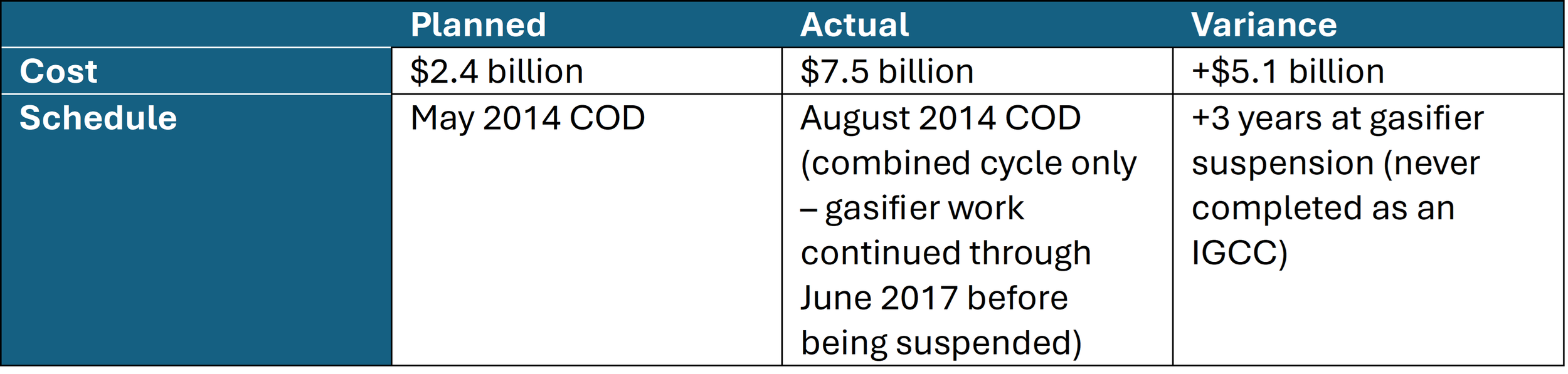
Planned vs. actual cost and schedule - Kemper IGCC
As shown above, both of these projects experienced significant cost and schedule growth. The Kemper IGCC project never actually achieved commercial operation of its gasifier portion of the plant following the combined cycle portion of the plant being placed in-service in August 2014 (continuing to operate today as a natural gas combined cycle facility). While the Edwardsport IGCC project was successfully put into service as an IGCC facility, it has experienced outages and maintenance issues, leading to lower output capacity and large cost growth with the O&M costs of operating the facility.
Addressing Uncertainty in Project Definition
We noted above how CPCN applications typically include project information and definition that is more conceptual in nature, reflecting the early state of development for the proposed project. We also have demonstrated how this lack of project definition exposes the project to potential issues, notably cost and schedule growth as well as diminished benefits. These risks were also recognized within each project’s respective Order that issued the CPCN, though each also noted the utility’s confidence in its filed estimate.
Within the Edwardsport IGCC Project’s Order, the Commission emphasized the Company’s high level of confidence in its cost estimate, while recognizing “…that certain parties have predicted that costs of the IGCC Project will rise and that a cost-cap is therefore necessary.”
Within the Kemper IGCC Project’s Order, the Commission noted:
“While the physical project itself, in concept, could benefit MPC’s ratepayers, the proposal’s many uncertainties and risks, concerning technology, cost and performance, given MPC’s insistence that these uncertainties and risks fall largely on ratepayers, are too high compared to the project’s asserted benefits.”
The Commission added,
“Several parties emphasized, and this Commission is concerned about, potential risks to customers, and to MPC, posed by the Kemper IGCC Project, including capital cost risk, performance risk, first of a kind technology risk, project cancellation risk and the potential loss of federal incentives.”
For the Edwardsport IGCC Project, the Commission initially did not adopt a cost cap, opting to utilize other regulatory tools available to provide regular updates to the project’s progress and cost performance. In the first semi-annual rider filed by the utility, it reported an updated cost estimate of $2.35 billion (or 18% above the CPCN estimate). Cost growth on the project continued in subsequent updates that saw the cost estimate increase to $2.88 billion. This continued cost growth prompted the utility to volunteer a cost cap of $2.72 billion in direct construction costs, which was negotiated with the other parties and resulted in a hard cost cap of $2.595 billion (plus AFUDC costs).
While on the Kemper IGCC project, the Commission’s CPCN Order included a set of conditions that the utility needed to accept to receive the CPCN, which included a cost cap of 20% above the utility’s estimate (equivalent to $2.88 billion). The Commission’s CPCN Order also established that both the Commission and Commission Staff would engage an independent monitor to assess and provide updates to the parties on the project’s progression.
Thus, the primary regulator methods for addressing the risk and uncertainty associated with the limited project definition on these projects involved ongoing reviews, including use of independent monitors, and establishing a cost cap effectively at a point where increased costs of the project are still in the interest of rate payers for the benefits they are receiving from the project. From the utility perspective, the cost cap shifts the risk of cost overruns from the rate payers to the utility, which can in theory be passed to other parties such as the EPC contractor via lump-sum pricing, but as lump-sum pricing is not always available or warranted, the utility should nonetheless ensure it is prepared to address these risks. Naturally a robust risk management program is recommended, particularly in the planning and development phase of the project that features much more uncertainty than later in the project’s execution phase (though specific risks, like startup and commissioning risks, naturally continue to be present throughout execution). Having robust risk management processes in place early in the project allows these risk management efforts to actively inform other aspects of the project’s planning and development, including development of risk mitigation plans. Early engagement of the main engineer and contractor for the project may also be warranted to provide early alignment amongst these key project partners, including goal alignment through establishing target cost and schedules with joint risk/reward sharing.
Closing Thoughts
With regulatory approval of electric utility projects often taking place while the project is still at an early or conceptual stage of definition, it can lead to significant uncertainty around the cost, schedule, performance, and ultimate customer value of the project. We showed through the examples on the Edwardsport and Kemper IGCC projects that these large first-of-a-kind type projects encountered significant cost growth, schedule delays, and operational challenges after regulatory approval was received. These uncertainties can be partially mitigated through early risk management efforts and early alignment with key project partners, while regulatory tools such as cost caps, independent monitoring, and regular status reporting can similarly help manage these risks for key stakeholders.