
Independent Monitoring
Within this article we examine what independent monitoring entails, including what project elements are typically examined, examples of where independent monitors have been utilized, and the resulting benefits of engaging an independent monitor to review and report on the delivery of major projects and programs.
What is Independent Monitoring?
Independent monitoring involves the use of outside experts to collect, measure, and assess the health of a major project/program and is commonly applied in the utility and infrastructure industries. In some respects, it is synonymous with the work performed by an “expert review panel” or a “technical advisory committee.” The overall objective is to provide the sponsor and key stakeholders with recurring and objective feedback on the progress of achieving the intended results of the project/program throughout its execution.
Critically, an independent monitor does not replace the role of the project management team. The project management team remains responsible for implementing the processes necessary to deliver the project, including building and managing the team, communicating with partners, controlling cost and schedule, managing risk, and maintaining quality. The independent monitor instead interfaces with the project management team to develop its assessment, including participation in project meetings as appropriate, gathering data and receiving feedback on the status of the project/program.
The performance monitoring provided by the independent monitor provides stakeholders with recurring information on the progress of the project/program, including offering a review of the initial assumptions and objectives of the project/program to determine if they still are valid and whether the original execution strategies remain appropriate. This information provides guidance to the sponsor, stakeholders, and decision-makers on what is and isn’t working as intended, the positive and negative factors influencing results, and identification of lessons learned. The result is the parties have an well-informed view of the current project/program status, reducing the likelihood of last minute surprises or issues left unaddressed..
What does the Independent Monitor, Monitor?
Generally, the independent monitor is engaged as the project/program is beginning the execution phase and the engagement continues through the completion of the project/program. However, for extremely large and complex project/programs (i.e. megaprojects), the engagement of the independent monitor may begin in the planning phase to provide stakeholders with critical status reports to inform decision-making at this early phase of the project/program where key decisions have the most influence on the overall outcome of the project/program.
In all cases, it is helpful for the parties requiring or engaging an independent monitor to agree in advance on the indicators and standards that will form the basis of the monitoring. This allows the independent monitoring expectations of the stakeholders to be formalized and provides the project/program management team with an awareness of the type of information that the project team will be required to gather and share with the independent monitor.
The specific scope of the independent monitor’s efforts can be modified to meet the distinct needs of the stakeholders that are engaging the independent monitor. As mentioned above, the independent monitor can evaluate the initial assumptions, objectives, and execution strategies of the project/program. Typically, other key scope items include, at a minimum, recurring assessments of the primary project/program management elements such as cost, schedule, and scope. In some cases, compliance with regulatory or other governmental mandates may also be a key area of evaluation. The graphic below summarizes the typical program/project elements that are included in an independent monitor’s scope of review.
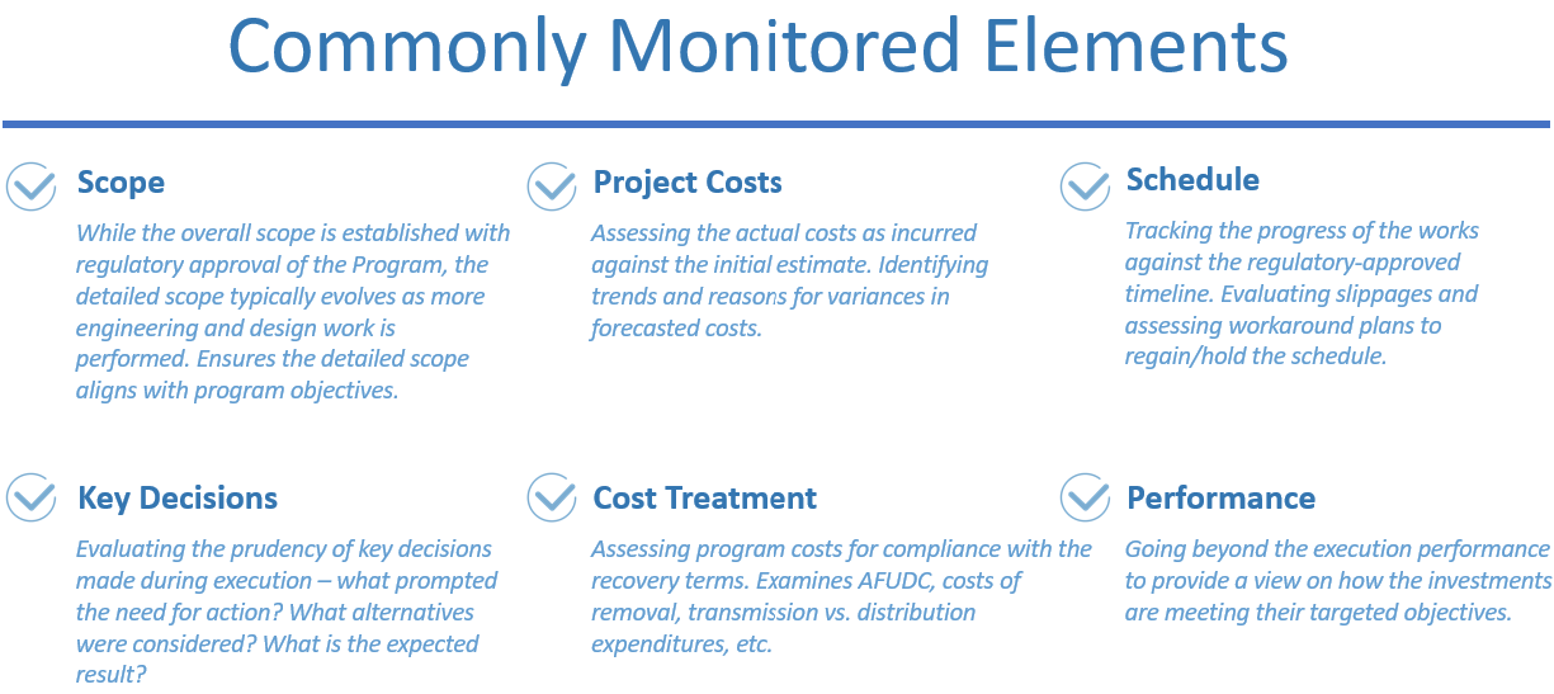
Project elements commonly monitored by an independent monitor
As challenges are encountered during the project/program execution, additional focus can be given to these challenges to provide the parties with an objective view of the impacts and responses to such challenges.
Where Has an Independent Monitor Been Utilized?
The use of independent monitors has grown following the growth of megaprojects, which are known to commonly encounter cost and schedule overruns and have heightened interest from stakeholders. One example was the Kemper IGCC Project executed by Mississippi Power Company. This highly complex first-of-a-kind megaproject was the largest project ever carried out by the utility or its regulator (the Mississippi Public Service Commission). As such, the Commission identified the need to have regular updates on the progress and status of the Project through its execution. Commission Staff recognized the same need and opted to engage its own independent monitor to have greater influence on the independent monitor’s scope. Both of the independent monitors engaged on this Project maintained an onsite presence and filed testimony in the utility’s prudence hearings before the Commission.
As the size and complexity of projects/programs continues to grow, along with the need for independent monitoring, certain government or regulator entities have formalized the use of independent monitors into code. This is the case in New Jersey, where substantial infrastructure investments have been made to mitigate the impact of future Hurricane Sandy-like storms. The relevant New Jersey code (N.J.A.C. § 14:3-2A.5) states:
“[The Board of Public Utilities may require that the utility] Retain an independent Infrastructure Investment Program monitor, as a condition of approval of the utility’s petition, to review and provide quarterly or semi-annual reports to the Board and to the Division of Rate Counsel, where the monitor shall be paid by the utility. If the Board requires an independent Infrastructure Investment Program monitor, the monitor’s reports shall address:
i. The effectiveness of Infrastructure Investment Program investments in meeting project objectives;
ii. The cost-effectiveness and efficiency of investments;
iii. The appropriateness of cost assignments; and
iv. Any other information required by the Board.”
Pegasus-Global has served, or is currently serving, as the independent monitor for five such infrastructure investment programs in New Jersey, collectively representing over $2.3 billion in distribution investments targeted at improving the resiliency and reliability of the utility’s system.
Benefits to Using an Independent Monitor
The most direct benefit to utilizing an independent monitor is the parties gain an unbiased, independent, and expert view of the status of a major program or project. What this supports is the avoidance of surprises by alerting the parties to potential issues early, allowing the issues to be mitigated and resolved before more adverse impacts are realized. This is particularly helpful both in multi-year efforts, where unaddressed issues may linger in the background until it is too late to respond, and in today’s post-Covid 19 world, where uncommon or unexpected impacts are still being encountered.
Likewise, the independent monitor’s scope can be viewed as essentially providing a real-time prudence review that ensures the utility has the appropriate records and decision-making processes in place to support its rate filing. As the Mississippi Public Service Commission noted in its Final Order on Remand for the Kemper IGCC Project, “The presence of an IM allows this Commission to routinely assess the status of the Kemper Project. The ongoing monitoring negates the need to rely upon intervening parties to prompt a re-opening of the record to accept additional evidence.”
The above benefits are also accomplished in a minimally intrusive approach, where the project management team remains in control of the actual planning, execution, and oversight of the works, while the independent monitor relies on commonly produced project records (e.g. schedules, cost estimates, progress reports, etc.) and interviews or discussions with the project management team to inform its findings.
Closing Thoughts
Independent monitoring provides sponsors, regulators, and stakeholders with an objective and recurring view of project health without displacing the role of the project management team. By reviewing key areas such as cost, schedule, scope, assumptions, execution strategies, risk, and regulatory compliance, an independent monitor helps identify issues early, validate whether project objectives remain achievable, and strengthen the information available for decision-making. As major utility and infrastructure programs continue to grow in size, complexity, and public importance, independent monitoring offers a practical mechanism for increasing transparency, reducing surprises, and supporting well-documented outcomes throughout the project life cycle.