
Reintroducing Megaprojects
Megaprojects are well-known throughout the world and represent a wide range of scopes executed under a variety of strategic management practices. Within this article, we review the common characteristics that define megaprojects, introduce the gigaproject class of megaprojects, review issues and challenges often encountered on these large and unique projects, and provide recommended practices to support successful megaproject delivery.
Megaproject Characteristics
What makes a megaproject a megaproject?
The common characteristics of a megaproject include:
Capital costs over $1 billion (USD).
Multi-year construction duration – and often longer than a decade from feasibility planning through execution.
Comparably high benefits and correspondingly high risk.
Long duration and complexity increases exposure to “black swan” type events.
Heightened political involvement and public interest.
Many diverse stakeholders that may have conflicting needs and objectives, but can also have meaningful impacts on the project (strategically, environmentally, economically, etc.).
Unique scope, often with first-of-a-kind aspects – not just a bigger version of a smaller project.
Multiple prime contractors and vendors/suppliers to support the project.
Gigaprojects
With the size and scale of some megaprojects going well above and beyond the common megaproject thresholds, the term “gigaproject” is used to add distinction to these exceptionally large megaprojects.
Gigaprojects typically have capital costs above $10 billion (USD) and may even exceed $100 billion in some cases. With these immense capital costs, the scale is similarly massive and may involve a strategic transformation by the project’s sponsor – with heavy government involvement common. They may also involve multiple individual megaprojects within the overall scope.
Megaproject Challenges
With their large size and many complexities, megaprojects naturally face execution challenges above and beyond “typical” projects. Common challenges on megaprojects include:
Long planning & execution horizons – making it difficult to accurately plan future conditions and also exposure to different political cycles.
Complex interfaces and interdependent risks.
Scope/components that are often not standard.
Decision-making and planning that involves multiple parties with conflicting interests.
Unplanned events (including “black swan” events) are typically not accounted for – but megaprojects have increased exposure to these high-impact events.
These challenges regularly lead to megaprojects facing significant cost increases, schedule extensions, and may lead to the project’s being cancelled or abandoned prior to completion.
However, despite these issues, completed megaprojects generally still provide their intended benefits – even if at a higher cost than planned.
Examples of Root Causes for Megaproject Cost Overruns & Delays
We’ve demonstrated the unique challenges faced by megaprojects and how that can translate into cost and schedule impacts, the graphic below provides a view on how these impacts can arise from several internal and external project factors across the entire project lifecycle.
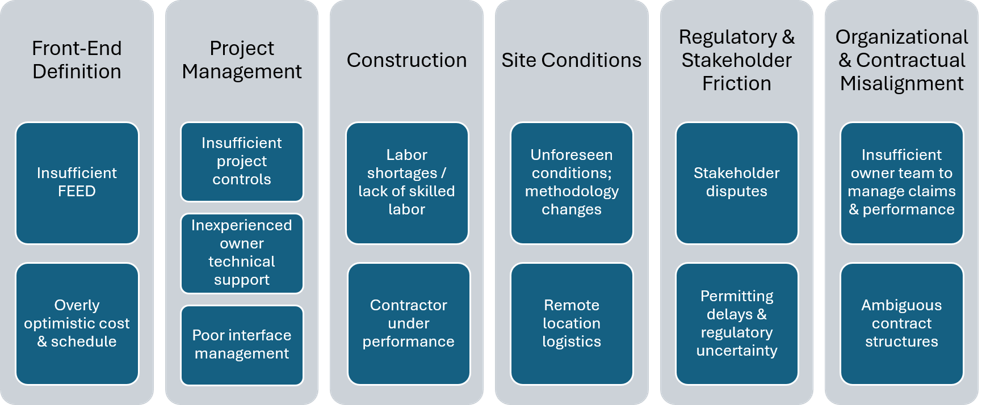
Examples of root causes for megaproject cost overruns & delays
The takeaway here is really that cost and schedule impacts can come from anywhere stressing the importance of strong project management to identify and mitigate issues before they have more severe impacts.
Megaproject Management
Given the size, scale, complexity, and challenges common to megaprojects, standard project management approaches are often not sufficient to address the demands of a megaproject. So how can you prepare to successfully plan and deliver a megaproject?
Strong Front-End Development
While standard projects rely heavily on execution-phase controls, megaproject success or failure is often established before the execution phase begins. In the planning and development of a megaproject focus should be applied to ensure the following steps are integrated into the planning phase:
Rigorous scope definition
Early risk modeling
Realistic cost and schedule baselines
Early stakeholder mapping and involvement
Mission-Focused Governance
Standard projects are often delivered within a single organization, with the size and scope of megaprojects, they typically involve partnerships or outside influence from government bodies, communities, and global partners. Because of this, the governance structure and leadership must be able to align institutions and not just functional teams. This can be supported through:
A clear mission that aligns diverse stakeholders and guides complex decision-making.
Governance that is adaptive, translating the vision into frameworks that coordinate various elements and parties.
Strong leadership that maintains focus through multi-year turbulence.
Early Contractor and Vendor Integration
Standard projects may treat contractors and vendors as downstream contributors to the project, whereas megaprojects benefit from partnering with contractors and key equipment/material supplier early in the development phase to allow them to shape constructability based on their distinct expertise. This reduces the interface risk on megaprojects and also supports accelerated mobilization.
Systemic Risk Management
While standard projects may treat risks as discrete and isolated items, risks on megaprojects are often interdependent, where one risk impact cascades across the entire project. Additionally, with their size and scope, megaprojects naturally face risks above and beyond standard projects. Best practices to support megaproject risk management include:
Early and continuous risk reviews.
Scenario modeling.
Explicit contingency structures.
Program/portfolio level risk registers.
Multi-Level Stakeholder Management
Standard projects typically have limited stakeholders that have similarly limited ability to influence the project. The size and scope of megaprojects inherently involves a variety of stakeholders that have differing abilities to influence the project. Because of this increased stakeholder complexity on megaprojects all stakeholders need to be identified and regularly engaged with structured feedback processes that allow alignment towards a shared long-term vision.
The better aligned stakeholders and partners are, the more prepared they are to address and mitigate risks. Practices to align stakeholders include early engagement of key stakeholders, shared governance, collaboration, shared financial incentives (risks and rewards), and a "no-blame" culture of open communication among key stakeholders that works towards common goals and objectives.
Organizational Design
Because of the extended duration of megaprojects, they have higher exposure to resource turnover than typical projects. If not properly planned, this resource turnover can lead to the loss of institutional knowledge on the project as well as potential resource shortages. To support stable and high-quality megaproject delivery teams, the organization should:
Implement a defined chain of command and establish clear roles and responsibilities.
Identify the capabilities and capacity of internal resources and where external support is needed.
Prepare for succession planning that supports the retention and transfer of institutional knowledge.
Integrated Planning & Continuous Monitoring
The complexity of megaprojects demands integrated and multi-disciplinary efforts that includes robust cost, schedule, and risk planning. As an example, bringing operations into the planning allows validation that the planned scope will function as intended and avoids unnecessary issues during the commissioning of the project.
With the expectation that conditions will change during the course of delivering a megaproject, strong oversight and change control becomes paramount to the success of the project. Continuous monitoring with as near to real-time information as feasible allows management to have an informed view of the project’s status, enabling corrective or mitigative actions to be taken in a timely manner.
Closing Thoughts
Megaprojects are unique projects that have immense complexity that requires practices beyond typical project management. While the demands of megaprojects can be significant and may quickly overwhelm an inexperienced or underprepared sponsor, the practices discussed above support a pathway to successful delivery of these important projects.