
Within this article, we discuss what phase-gating is and how it is used on megaprojects and include a discussion on challenges raised by phase-gating and recommended practices for implementing phase-gating on a megaproject.
What is Phase-Gating?
Phase or stage-gating is a common governance approach applied to the planning and execution of megaprojects that involves defined points, or “gates”, in a project’s development where key stakeholders review the status and deliverables associated with that stage of the project before approving the project to advance to the next stage, with the “gate” serving as a formal decision point for senior/executive management.
Within different industries the specific terminology around the phase gates differs, however it commonly involves the sequential and structured advancement of a project. The figure below depicts common high-level phases of a megaproject development that can serve as formal gates in the phase-gating process.
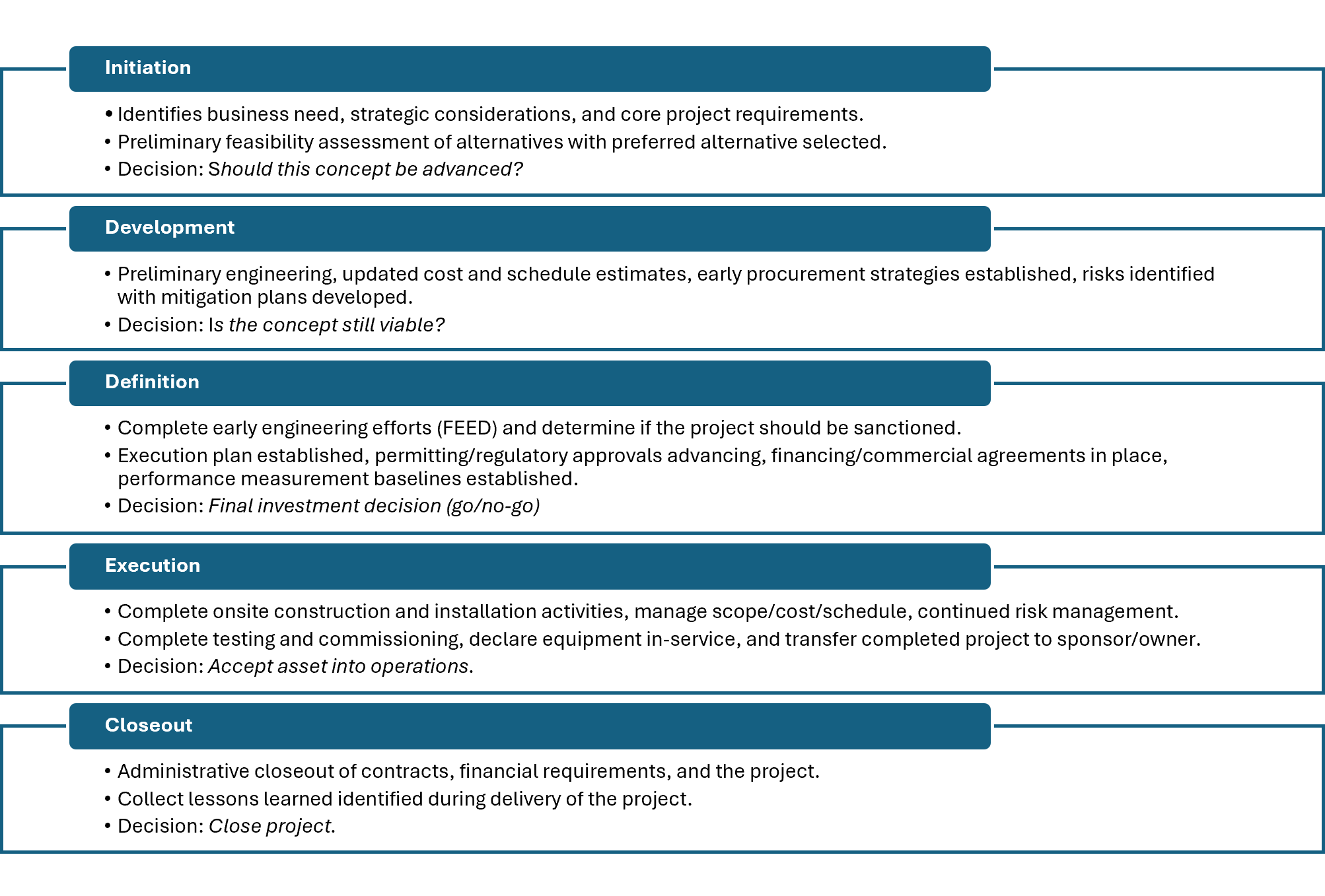
Common high-level phases of megaproject development
As with most recommended practices, the application of phase-gating should align with the needs and objectives of the owner organization and the project characteristics. For example, it may be beneficial to add a gate between definition and execution that allows for a readiness to execute check to be performed prior to mobilization in the field.
How is Phase-Gating Used?
The phase-gate process provides a structured approach to manage the progress elaboration and refinement of a project’s development, including its scope, schedule, and cost. This allows senior and executive management to have an informed view on the project’s delivery, including around the areas of:
Performance: reviewing whether the previous phase was executed in alignment with requirements (scope, cost, schedule, safety, quality, etc.) and taking remedial action if required.
Business Case: confirming that the project remains aligned with the strategic objectives of the organization.
Planning: assessing whether the next phase of the project has been adequately planned prior to advancing.
For senior/executive management to make an informed decision on whether or not to advance the project to the next phase, a pre-defined set of deliverables is associated with the gated review. For example, at the “Definition” phase-gate from the figure above, common deliverables include the FEED engineering package, a Class 3 cost estimate, an integrated project schedule, long-lead procurement packages ready for award, labor requirements and availability confirmed, etc. These phase-gate deliverables are reviewed by the key stakeholders in advance of a gate decision meeting that provides the venue for senior/executive management to decide if the project is ready to advance to its next stage.
Phase-Gating Challenges
While the phase-gate process provides structured control over the planning, development, and execution of a megaproject, if it is not adequately planned and implemented it can present unintended consequences to the project’s delivery. Below we highlight potential drawbacks in terms of structural, behavioral, and strategic consequences.
Structural Drawbacks
Rigid sequencing can slow momentum: intended windows of opportunity may be missed when adhering to a rigid phase-gate process, even if partial advancement would be low-risk.
Overemphasis on deliverables over insight: focus on generating material to satisfy gate requirements rather than promoting actual readiness/risk reduction.
False sense of certainty: progression of phase gates may lead to assumption that risk decreases in a similarly linear manner; megaprojects in particular have heightened exposure to unknown-unknowns and black swan type events.
Behavioral Drawbacks
Incentivizes optimism biases: pressure to pass the gate and avoid inconvenient truths.
Creates adversarial dynamics: delivery teams may see governance has a hurdle rather than a partner; gatekeepers may take on more of a compliance role rather than serving as a strategic risk steward.
Discourages adaptive decision-making: overly rigid processes may cause the project team to avoid mid-stage pivots, even if new information clearly warrants it, because it means reopening a gate.
Encourages risk avoidance rather than risk management: teams may avoid innovative solutions in lieu of a simpler approach to satisfy the gate requirements.
Strategic Drawbacks
Misalignment with megaproject uncertainty: megaprojects often evolve non-linearly, with stage gates providing false senses of scope, schedule, or cost being “locked”.
Slow escalation of emerging risks: identified risks may grow/change between formal risk reviews; additional issues may emerge without continuous oversight of risks.
Can delay procurement and contracting: the gate cycle and timing may not align with long-lead procurement requirements; adds exposure to price escalation, supply chain volatility, etc.
Fragmentation across partners: multi-owner or public-private partnerships may have distinct phase gate processes for each party resulting in a patchwork of overlapping gates with unclear authority and slow alignment.
Overall, the phase-gate is found to particularly excel when the project is more routine than unique and is within a stable environment (regulatory, market, labor). When uncertainty is higher and risks evolve quickly, enhancements to the phase-gate process can be incorporated to better address these challenges.
Phase-Gate Adaptations
While phase-gating is a common governance practice applied to the development of megaprojects, there has been growing interest in merging elements of Agile project management techniques to the phase-gate process to support more adaptative governance. Agile project management is commonly utilized within the IT industry and supports speed and flexibility in delivering a project by applying an iterative project development lifecycle that focuses on adapting to changes as the project progresses.
This hybrid phase-gate approach incorporates Agile project management approaches into the phase-gates. This supports a feedback loop during the project development and allows the project team to respond more dynamically to the feedback received. A comparison of these governance approaches is shown below.
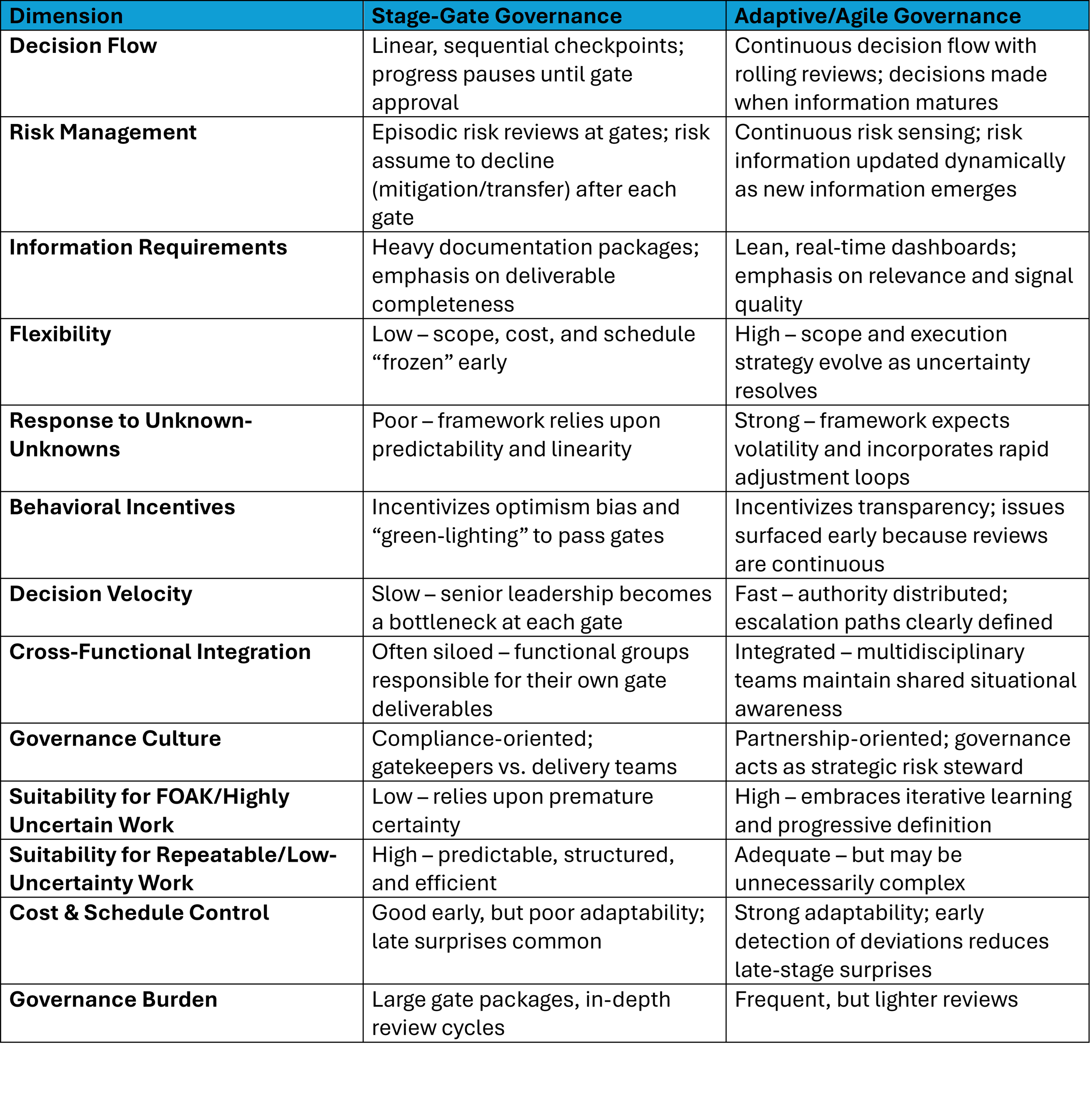
Stage-gate governance compared to adaptive/agile governance
Phase-Gating Best Practices
While phase-gating can present challenges such as those discussed above, it remains an effective megaproject governance tool that excels when it appropriately defined and implemented with buy-in from key stakeholders. A number of recommended practices have been identified that help enhance the phase-gate process, including incorporating elements of adaptive governance techniques detailed above for more complex and uncertain projects. Other recommended practices to improve megaproject delivery include:
Continuous Risk Management
Ensure risk management remains an ongoing effort with regular updates and reporting on risks and not merely a phase-gate deliverable.
Escalate risks as warranted, rather than waiting for a phase-gate review.
Rolling-Wave Planning
Assume and prepare for the plans to continue to evolve as the project nears execution rather than mandating “freezes” at artificial points.
Scalable Gates
Adapt the gate requirements to match the uncertainty of the scopes of work (e.g. lighter gates for Nth of a kind familiar work, more rigorous gates for FOAK scopes).
Transparent Risk Culture
Establish a transparent risk culture where passing a gate itself doesn’t become the goal.
Partner Alignment
For projects executed under partnerships, gain alignment on the phase-gate process as early as possible.
Adapt a “one team” approach to effectively resolve issues.
Closing Thoughts
Megaprojects are unique projects that have immense complexity that requires practices beyond typical project management. While the demands of megaprojects can be significant and may quickly overwhelm an inexperienced or underprepared sponsor, the practices discussed above support a pathway to successful delivery of these important projects.